


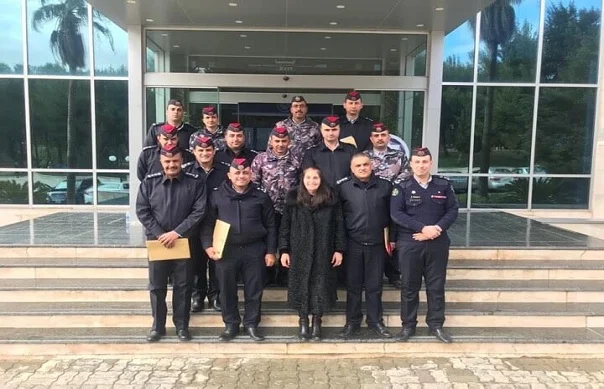
Out of the El Hassan Youth Award’s keenness to maintain communication with the General Directorate of Civil Defence and to discuss ways to strengthen the existing cooperation relations between the two sides in various fields that would provide training programmes for Jordanian youth and for participants in the Award programme at its three levels, Bronze, Silver and Gold, the El Hassan Youth Award office met with training liaison officers at the General Directorate of Civil Defence to discuss the work and cooperation plan and mechanism for 2020, on the morning of Sunday 9/2/2020 in the Hashemite Hall inside the Royal Scientific Society.
At the beginning of the meeting, Mrs. Samar Kaldani, Director of the El Hassan Youth Award, welcomed the officers participating in the meeting, appreciating the role of the General Directorate of Civil Defence and its great support for Jordanian youth in general and the El Hassan Youth Award in particular, based on the Directorate’s belief in the nobility of the Award’s mission and the nobility of its objectives. This belief was translated into a joint work plan that began implementation in 1998, represented by implementing the civil defence services programme to preserve lives and property, as all societies seek to strengthen and support young people, encourage them and overcome the difficulties they may face, because that will drive and accelerate the wheel of comprehensive development.
This requires the participation of young people, institutions and youth organisations in earnest and sincere work to achieve this development in the best way if opportunities for participation are available and the conditions for success are prepared.
During the meeting, the best ways to train young people in civil defence services topics were discussed through training courses that will be held in all Ministry of Education schools, youth centres and Jordanian universities this year. These courses will begin on Saturday 22/2/2020, at a rate of one hour per week and according to the requirements of each Award level, and will include theoretical training and practical applications specific to civil defence tasks and duties in the centres where training is conducted, followed by peer education for young people in schools and universities with the new experiences, information and knowledge gained.
The idea of the civil defence services programme was also explained. It aims to understand civil defence duties, divisions and formations, introduce the causes of fire and how to limit them, introduce the citizen’s duties in preventing fire, bleeding and suffocation accidents, and train in cardiopulmonary resuscitation and fractures in general and how to provide first aid. In addition, young people are trained in civil defence services, which include ambulance, firefighting, rescue and guidance, as their training and qualification creates volunteers in the field of civil defence who can help train others and guide them on how to act during crises. The responsibility for saving people is no longer only the responsibility of official agencies, as these agencies, no matter how precise, efficient and capable, cannot be present at the right time and place. Therefore, there must be volunteers trained in firefighting, artificial respiration and first aid and organising crowds until the competent authorities arrive.
The Award’s Director pointed out that young people constitute a large part of their society and are distinguished by vitality and the ability to work actively, and they are the source of change and renewal through their possession of noble human values. From this standpoint, the El Hassan Youth Award was the first supporter and follower of young people, offering innovations that crystallise in several programmes: services, skills, sports and the journeys programme. These programmes are characterised by their quality and good management, which has enabled the Award to rise towards internationalism.
The training officers affirmed that the Civil Defence Directorate seeks to spread civil defence services and to continually emphasise the presence of safety measures in universities, factories and residential and commercial complexes, noting that the role of civil defence complements and supports all official and private institutions to enhance the protection of property and lives. This was clear and evident in the reception of students of the citizenship and belonging course introduced by the Award and Yarmouk University at the Irbid Civil Defence Directorate.